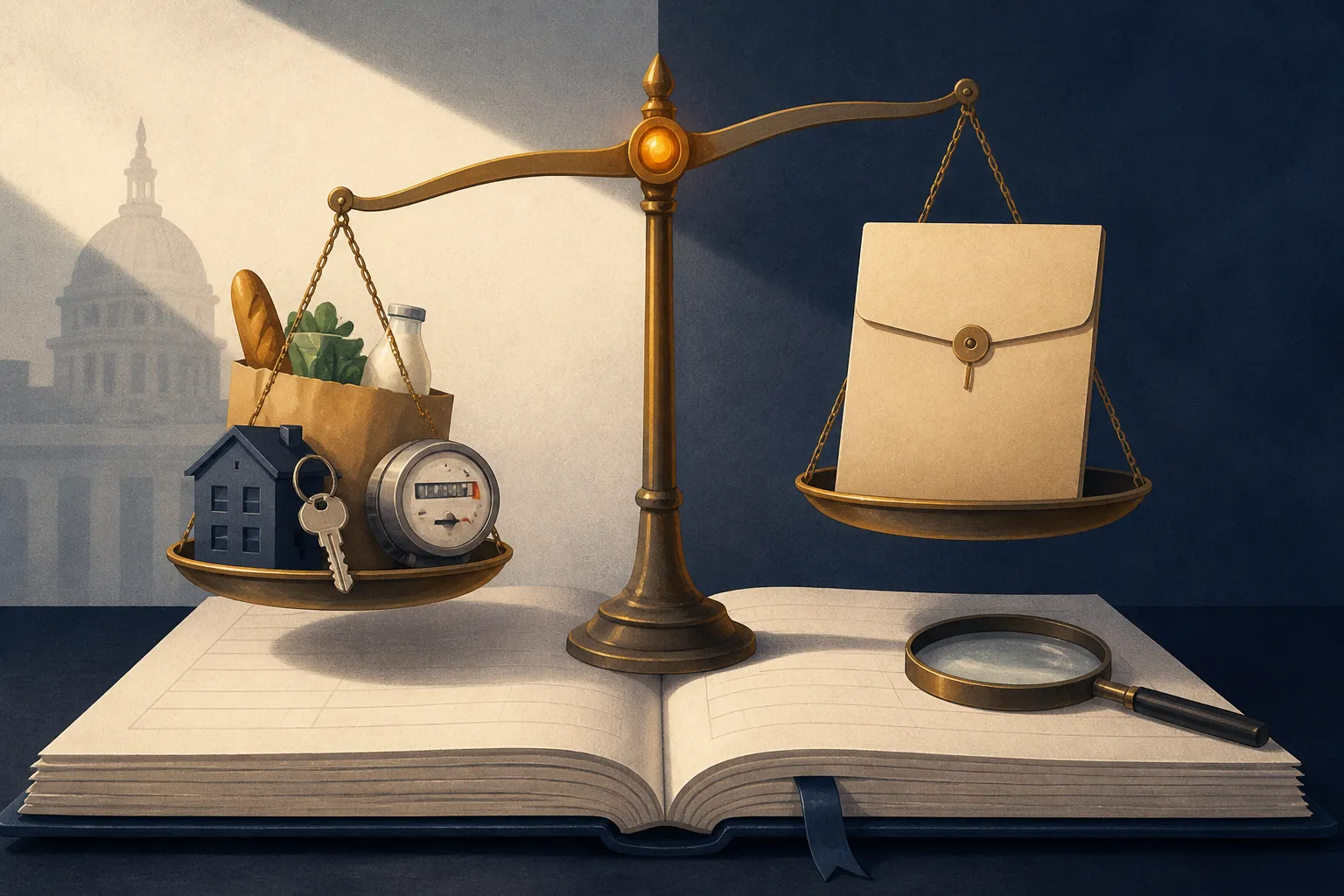
Sixty-three months. That is how long inflation had run above the Federal Reserve's 2 percent goal, according to a 2026 report by Eli Kronenberg in The Dispatch. The Atlanta Fed says inflation on the Fed's preferred gauge has stayed above 2 percent since 2021. A streak like that raises a fair question. Why does the Fed aim at 2 percent at all?

What the 2 percent target is
The Fed says it aims for inflation of 2 percent over the longer run. According to the Atlanta Fed, the target is set to comply with the mandate from Congress to foster price stability and maximum employment. The Fed's own pages on the goal are listed in the Fed FAQ on the 2 percent target and the FAQ on its economic goals. The text of those pages was not available to me when I wrote this, so the mandate description here rests on the Atlanta Fed's account.
The number is fixed and public on purpose. The Atlanta Fed describes the idea this way: if people trust that prices will rise slowly and steadily, inflation stops being a big factor in household and business spending decisions. The Dispatch likewise describes the fixed target as a signal to markets and consumers.
Picture a store owner setting prices for next quarter. If she trusts that costs will drift up about 2 percent a year, she has less reason to pad prices out of fear. A landlord drafting a renewal letter faces similar guesswork. A steady target is meant to calm it. It is a signal, not a guarantee.
Which inflation number the Fed watches
The Fed's preferred measure is the personal consumption expenditures (PCE) price index. Many news reports quote the consumer price index (CPI) instead. The two can tell different stories, so the figure in a headline may not match the one the Fed is tracking.
The sources I reviewed do not explain how the two measures differ. For the technical details, check the Bureau of Economic Analysis for PCE and the Bureau of Labor Statistics for CPI. The practical step is simple. Before you compare any number with the 2 percent goal, find out which measure it is.
The Atlanta Fed also reports that headline inflation was 2.7 percent in October 2025. It says the President called that figure "almost a perfect number." Others read the same figure as proof that inflation had not come down enough. Both are opinions layered on one number.
How the target connects to interest rates
The Fed's main tool is the federal funds rate. That is the overnight rate at which depository institutions lend balances held at the Fed to other institutions. According to the Atlanta Fed, the Fed would raise that rate when inflation rises above 2 percent. It would lower it when inflation falls materially below 2 percent, especially if employment is at risk.
You do not borrow at the federal funds rate. Still, the Atlanta Fed says it influences rates on many consumer loans and credit lines. Through that channel, the Fed affects consumer spending and, over time, the broader economy.
The sources do not say how this plays out in a household budget in concrete terms. They do not cover savings rates or loan costs either. What it means for you depends on your own loans, accounts and contract terms. Your lender's disclosures are the place to look. A qualified professional can help from there.
Projections and the history behind the target
After its policy meetings, the Fed releases a Summary of Economic Projections. It shows the median forecasts of policymakers. The Richmond Fed walked through a recent round. The median projection for headline PCE inflation in 2026 was 3.7 percent, up from 3.6 percent in June. Core PCE was projected at 3.4 percent, up from 3.3 percent. The median federal funds rate for the end of 2026 was 4.1 percent, up from 3.8 percent in June.
Each estimate moved up from June. That is one lesson of the projections: forecasts shift as new data arrives. Treat them as best guesses, not promises.
The target also has a history. Brookings explains that the 2020 framework reflected the Fed's struggle to get inflation up to 2 percent. It also reflected the memory that short-term rates were stuck at zero for seven years after the 2007-9 financial crisis. The framework was revised in August 2025 at Jackson Hole, after the Fed's every-five-year review of its goals and strategy. The target held. The approach to reaching it changed.
Questions to ask and what stays open
Start with the measure. If you track your own costs through CPI-based news, ask whether the Fed's PCE reading would show something different.
Next, look at your own paperwork. Do any of your loans or credit lines carry variable rates? Your account agreement answers that better than any rule of thumb. Then ask how a change in the federal funds rate might reach those loans.
Expect noise as well. The Atlanta Fed notes that the target is debated and that the talk can turn heated and partisan. Read the Fed's own explanations first. Then compare them with independent analysis such as Brookings or the regional Reserve Banks.
Some questions remain open in the sources I reviewed. They do not give the Fed's official answer on why 2 percent was chosen over another figure. They also say little about where the number came from beyond general references.
This article is general education, not personal financial advice.