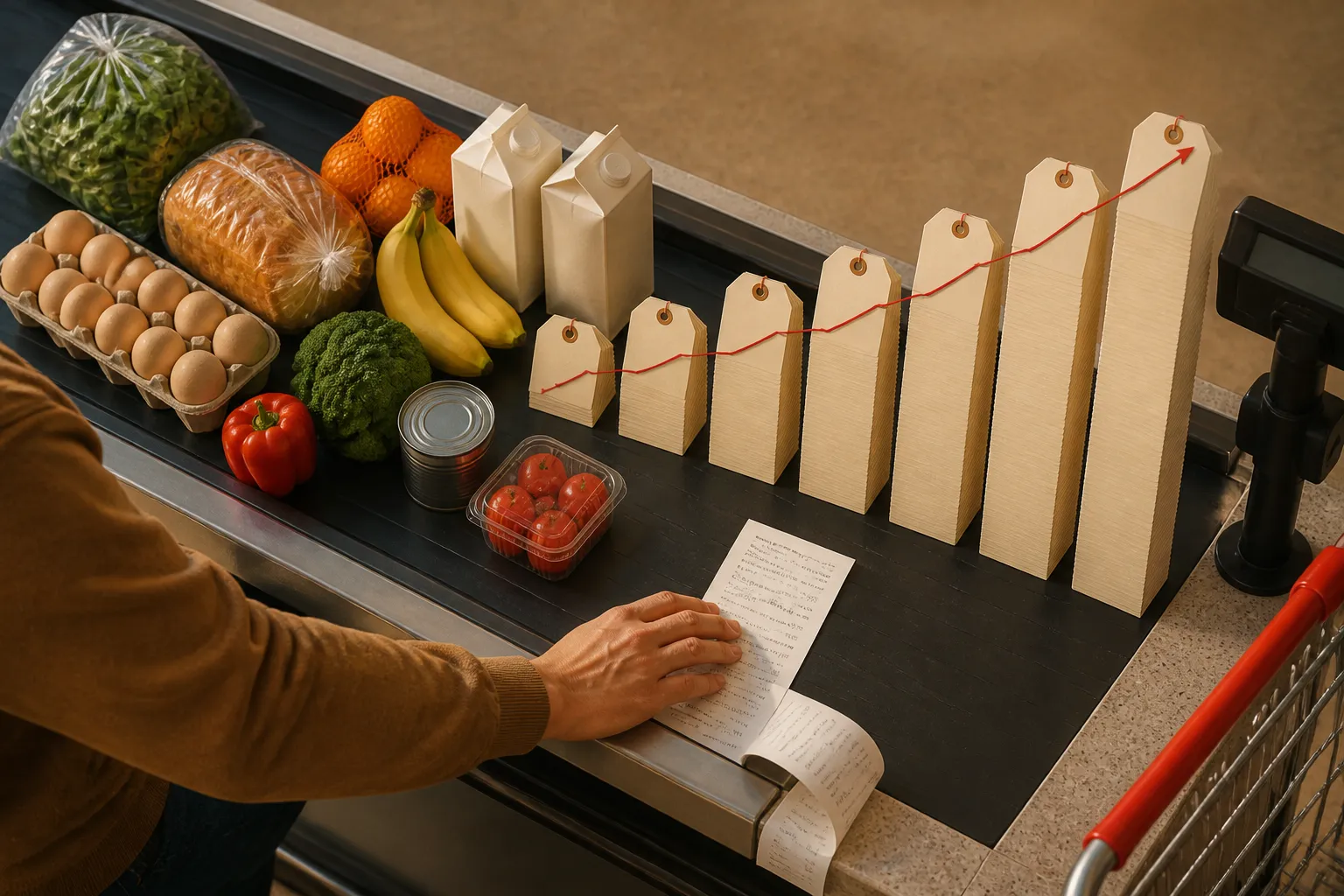











A shelf tag says $4.00. The register says $4.28 after tax, or $3.40 after a coupon. Which number does a consumer price index count? For the US CPI, the sources behind this piece cannot say. Guessing would be worse than admitting it.
What the available sources do not cover
The Bureau of Labor Statistics pages supplied for this article cover the CPI calculation, its concepts and its frequently asked questions. As captured, they hold site navigation and boilerplate, not methods. Nothing in them settles the question. Readers should not assume the US index handles sales taxes or discounts in any particular way based on this article.
The gaps are specific. The sources do not say whether state and local sales taxes are in the index. They do not say how a change in a tax rate would show up. They do not say how coupons, store discounts, loyalty pricing, sales events or rebates are treated. Those gaps matter, because a shopper's out-of-pocket cost can differ from the shelf price once tax and discounts are applied. A $4.00 item can end up as $3.40 or $4.28 at the register, and an index has to pick one.
What a basket index is
A consumer price index is built on a simple idea. Pick a large set of goods and services that a typical household buys. Price that set every month. Track how the total cost changes. The ONS describes its consumer price statistics in just this way, as a large shopping basket bought by a typical household, with the monthly change in its total cost measured as inflation.
The basket is a stand-in. It does not follow one person's receipts. The ONS notes that each household's experience of inflation differs, because no two households spend money in the same way. A shopper who clips coupons every week may see a personal price change that departs from the headline number. That holds whatever method an agency uses.
This is why the treatment of discounts matters. If the index records the shelf price, a coupon user's real costs fall outside it. If it records a discounted price, the index moves closer to what some shoppers actually paid. The choice shapes what the number means.
The UK loyalty card example
The only discount material in the sources comes from the UK Office for National Statistics (ONS). That agency is separate from the US CPI, so treat this as a comparison and nothing more. In a freedom of information response dated 22 August 2025, the ONS said that from late 2022 it began collecting loyalty card prices alongside shelf prices.
The ONS also ran an internal analysis in 2023, referenced as FOI-2023-1237 and dated 11 August 2023. It tested what would happen if discounted prices were used. It found no evidence that such an index would differ materially from the published UK CPI at the headline or divisional level.
The method is simple to describe. On discounted products, the shelf price is swapped for the loyalty card price. The standard inflation calculations then run on that modified data. The ONS also said it plans to bring in grocery scanner data. The source text cuts off before details. Details are in the ONS response on loyalty card discount schemes.
Sampling and data collection
The ONS says prices come from traditional sources: store visits, online checks and phone contact. It uses a sample of prices, not every price in the market. Details are on its traditional data page. Sampling choices help decide which discounts end up in the math, so the collection method matters. The ONS scope page is here.

The supplied sources do not describe BLS sampling, substitution or quality adjustment. Substitution means what happens when a product vanishes from a shelf and a similar one stands in. The BLS CPI questions and answers page is a natural place to look for the US answer. The copy supplied for this article held only boilerplate, so we could not verify what it says.
What this means for household budgeting
Published inflation figures are averages. Your own cost of living depends on what you buy, where you shop, whether you use discounts, and how sales tax applies where you live. Tracking your spending over several months can show how much those factors matter for your budget.
This article is educational only. It is not personal financial, legal or tax advice. For how sales tax applies to a purchase, ask your state or local tax authority. For the CPI's technical methods, the Bureau of Labor Statistics is the authoritative source.