











A claim payment check can look convincing and still deserve a closer look. The available guidance here covers check fraud in general, not auto insurance claim payments. It cannot establish what a particular insurer’s check should look like, how much a claim payment should be, or what to do with a check that seems suspicious. It can help explain some warning signs, and where the evidence stops.
Start with the gap between a claim and a check
A check is a payment document. An auto insurance claim is an arrangement between a claimant and an insurer. The sources reviewed explain ways checks may be altered or copied, but they do not describe how insurers issue payments, which names may appear as payees, or what payment amounts and formats are expected. A check that differs from what someone expected is a reason to verify the details, not proof by itself that the check is fake.
That distinction matters because appearance alone cannot confirm whether a payment is legitimate. Current technology can produce convincing counterfeit checks, according to the check-fraud guidance summarized by PNC. The most useful approach is to treat each visible detail as a clue, then compare several clues and seek confirmation through a source found independently. Contact information printed on a suspicious check is not independent verification.
Look for several physical clues
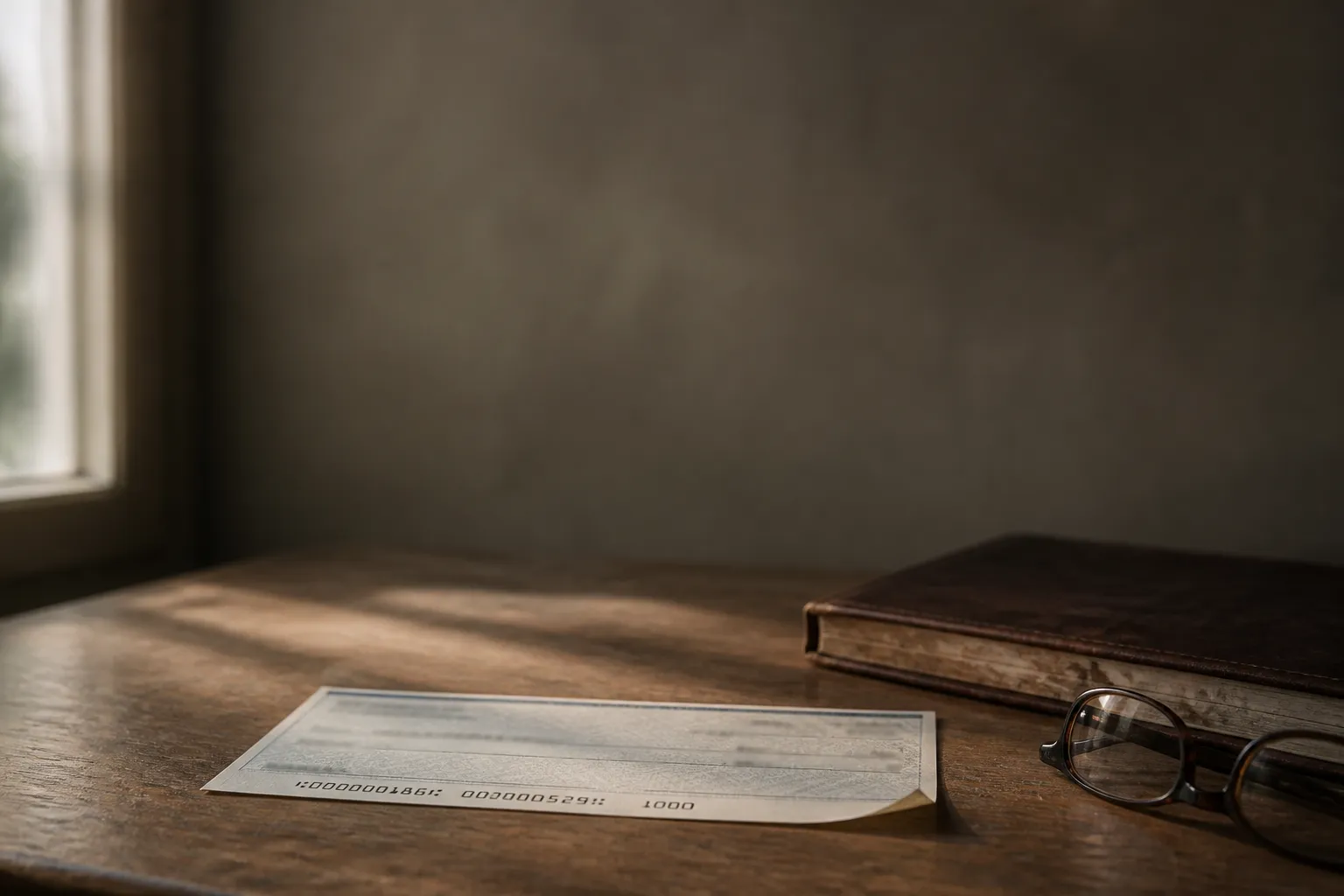
Start with the paper edges. Checks are commonly torn from a book, so at least one edge is usually rough or perforated. Four smooth edges can be a warning sign. Check the issuing bank’s logo as well. PNC says a missing or faded logo may indicate that an image was copied or taken from an online source. If the check lists a bank address, compare it with an address for a real branch found through an independent search.
The line of characters along the bottom is called the MICR line, short for magnetic ink character recognition. It generally contains the routing number, account number, check number, and two transit symbols. Federal Reserve rules require magnetic iron oxide ink for this line. The cited PNC guidance says the characters should look dull rather than shiny and lie flat rather than raised. A missing or unusual MICR line is a warning, but no single visual test can settle authenticity.
These checks are screening clues, not a certification process. A real-looking logo does not prove that the check was issued by the named bank. A rough edge does not prove that the payee or amount is unchanged. If one feature looks wrong, the next question is whether other details also fail to match.
Notice changes to the payee or amount
Check washing is a form of fraud in which someone steals a check, often from the mail, removes its ink with chemicals, and writes in a different payee or amount. Criminals may also make counterfeit copies with a copier or scanner. The U.S. Postal Inspection Service identifies a particular warning pattern: a check the intended recipient says never arrived has already been cashed by someone else.
For a claim payment, the sources do not explain how to compare a check with an insurer’s original payment record. They also do not say which payee names might be normal in a particular claim. If the printed payee or amount appears changed, that is a reason to seek a reliable explanation from the issuer, using contact details obtained independently rather than relying only on the check itself. This is a general verification principle, not an insurance-specific procedure supplied by these sources.
Mail theft can be part of the chain. The Postal Inspection Service advises putting outgoing mail in a blue collection box before the last pickup or taking it to a Post Office, rather than leaving it in a home mailbox overnight. For travel, it suggests holding mail at the Post Office or having someone trusted collect it. The agency says Postal Inspectors recover more than $1 billion in counterfeit checks and money orders each year. That figure concerns counterfeit checks and money orders broadly, not auto insurance claims specifically.
Separate a warning sign from a next step
A suspicious-looking check raises two different questions: does the document show signs of alteration or counterfeiting, and did the insurer actually issue the payment? The physical clues above relate to the first question. The sources do not explain how to verify an insurer, an adjuster, or a claim payment through an insurer’s own records. They also do not establish what a claimant should do after spotting a possible problem.
In particular, this source set does not say whether to deposit a suspicious check, how long deposited funds take to become available, or what can happen if a counterfeit check is deposited. It does not provide a specific reporting path or explain which agency handles an insurance-related check concern. The Federal Trade Commission’s consumer page is titled as guidance on spotting, avoiding, and reporting fake check scams, but the available excerpt contains no substantive instructions. The Office of the Comptroller of the Currency page excerpt likewise contains navigation text rather than usable guidance.
For a question about a specific claim, the evidence supports a cautious distinction: visual signs can flag a check for further verification, but they cannot confirm the claim or tell a reader what action is appropriate. Official information from the relevant state insurance department may help with insurance-specific questions. The available sources do not explain which state complaint channel applies, so readers with a particular dispute may need to consult official state resources or a qualified professional.
Keep the conclusion proportional to the evidence
A check with four smooth edges, a faded or missing logo, a mismatched bank address, or an absent or shiny MICR line merits scrutiny. So does an apparent change to the payee or amount. Those signs do not, on their own, prove fraud. Conversely, a check that passes a quick visual inspection is not guaranteed to be genuine.
The core lesson from general check-fraud guidance is modest: compare multiple features, treat unexpected changes as significant, and verify details using information obtained independently. Auto insurance claim rules and payment practices are outside the scope of the cited material. For those details, official insurer or state sources are needed, and a check’s appearance alone cannot fill that gap.
Please seek a professional. This article is general information, not financial, tax or insurance advice. Please seek a licensed financial, tax or insurance professional about your own situation.


