A checking account advertised with no monthly fee may still cost money when you use it. Another account may waive its monthly fee, but only if your deposits or balance meet specific conditions. The useful comparison starts with the written fee list and a simple question: What would these rules cost during an ordinary month, and during a difficult one?
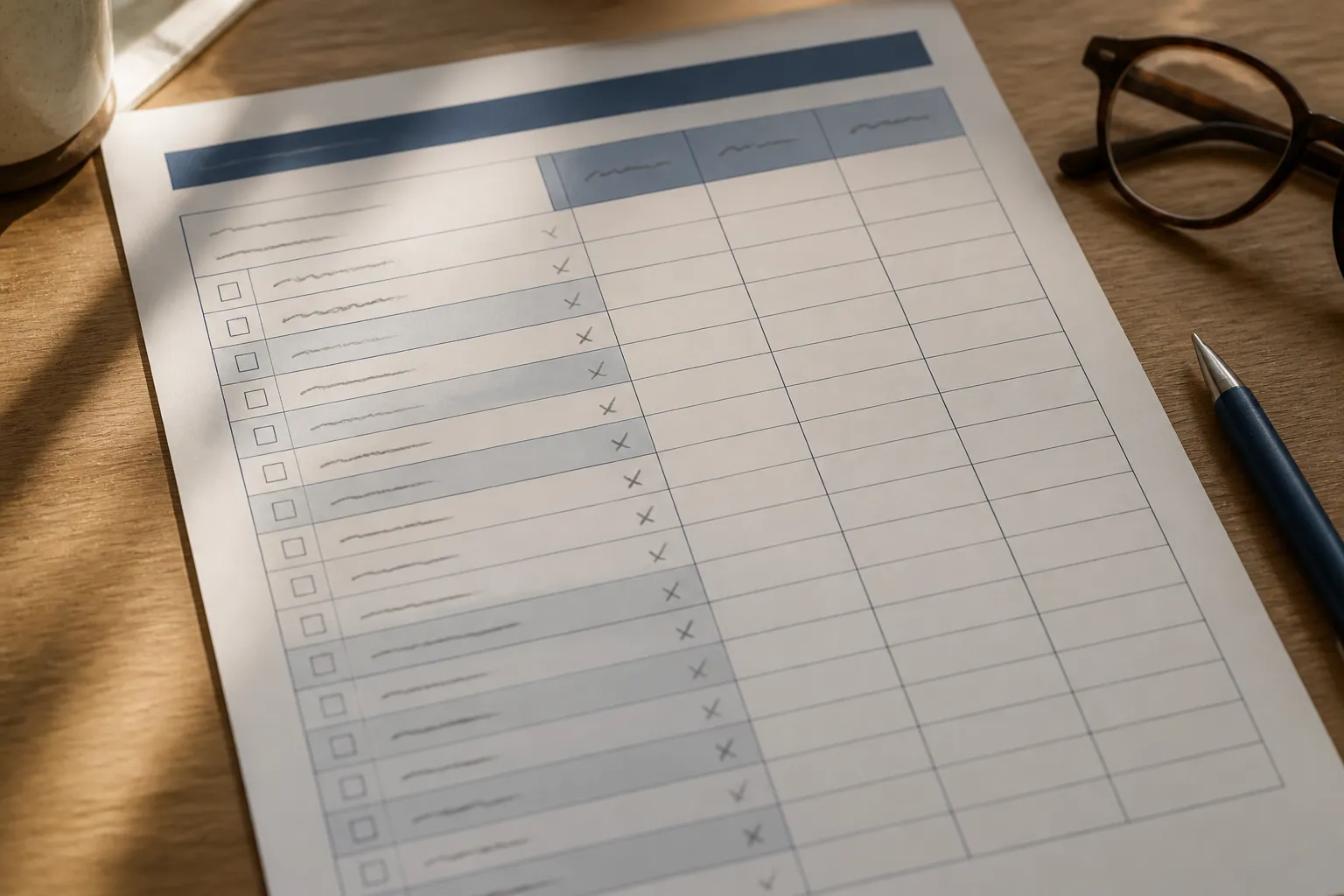
The Consumer Financial Protection Bureau, or CFPB, recommends requesting your current institution’s fee list and comparing it with other institutions’ charges. That gives you a baseline grounded in an account you already use, rather than an advertisement’s headline.
For each account, record three things together: the charge, what triggers it, and what prevents it. A dollar amount without its conditions is an incomplete comparison. So is a promise that a fee is “waived” without an explanation of how the waiver works.
Keep opening requirements and access rules alongside the fees. Money needed to open an account is different from money charged for maintaining it. And an account that looks inexpensive on paper may be inconvenient if the nearest usable ATM is far from your daily route.
Start with the full fee list, then test the exceptions
Ask for the complete written fee schedule, the document listing account charges, for the exact account you are considering. Institutions may offer several checking accounts with different terms. A general description of their services will not settle what your particular account would cost.
Begin with any recurring monthly charge. Then read the waiver conditions. If direct deposit prevents the fee, ask what deposits qualify and whether there is a required amount. If a minimum balance prevents it, ask how that balance is measured. A balance shown on one day may not answer whether you satisfied the account’s rule for the month.
A simple hypothetical shows why the exception matters: an $8 monthly fee would total $96 over 12 months if it applied every month. That is an illustration, not a typical market price. If the fee is waived in some months, the total changes. Compare the months when you would meet the condition with those when you might not.
Also ask about charges connected to the services you actually use, including ATM withdrawals, paper statements, checks, or transfers. Record the institution’s answer rather than assuming that a service is included because the monthly account fee is waived.
Separate overdraft choices from the monthly fee
An overdraft happens when a transaction takes more money from an account than is available and the institution pays it. The CFPB’s bank-account guidance addresses overdraft charges involving checks, electronic payments, and debit card transactions. These costs deserve their own comparison, separate from routine monthly charges.
The opt-in rule has an important boundary. For ATM and one-time debit card transactions, an institution generally needs your affirmative agreement before it can charge for paying an overdraft. That protection does not apply in the same way to checks or recurring electronic payments. Declining that particular coverage does not eliminate every possible overdraft charge.
Ask what happens in each case: a debit card purchase, a rent check, and a recurring bill payment when the available balance is too low. Would the transaction be declined, returned unpaid, or paid with a charge? Ask whether any separate returned-payment fee applies and whether there are limits on repeated charges. Get the applicable terms in writing before accepting optional coverage.
Distinguish the opening deposit from ongoing requirements
A minimum opening deposit is the amount needed to establish the account. It is not necessarily a fee, and it may differ from the balance needed later to avoid charges. Put those figures on separate lines so you do not mistake money deposited into your account for money paid to the institution.
Identification requirements also belong on the comparison sheet. MyCreditUnion.gov’s checking-account guidance describes opening requirements that commonly include identification, an application, and an initial deposit. Ask the institution exactly which documents it accepts before visiting a branch or beginning an online application.
Account ownership matters, too. An individual, joint, or minor account can have different access and management arrangements. If more than one person will use the account, ask who can withdraw funds, change services, and close it. Do not assume that the account’s name explains all of those rights.
Price convenience into the comparison
A low fee does little to solve an access problem. Check branch locations and hours against places you already visit. For ATMs, ask which machines are within the institution’s network and what charges may apply elsewhere, including charges imposed by the ATM operator.
Online and mobile access are useful only if they support the tasks you need. Ask how to report an unauthorized transaction, lock access after a lost card, or reach support outside branch hours. Readers who need accessible facilities or communication assistance should confirm what is available before opening the account.
Deposit timing is another practical limit. A deposit appearing in an account does not always mean all of it is available to spend. Federal rules limit certain check holds, but timing depends on the deposit and applicable exceptions. Request the institution’s funds-availability policy, which explains when deposited money can be withdrawn, rather than assuming every deposit works like payroll.
Check membership and deposit insurance separately
If you are considering a credit union, first confirm that you qualify for membership. Eligibility can depend on an employer, family relationship, location, or group membership. Some credit unions participate in shared branches and ATM networks, but the specific locations and services available still need checking.
MyCreditUnion.gov explains credit union membership and federal share insurance. The National Credit Union Share Insurance Fund covers deposits at federally insured credit unions, subject to coverage rules. The standard coverage amount is generally $250,000 per member-owner, per insured credit union, for each account ownership category.
Deposit insurance protects eligible deposits if an insured institution fails. It does not cancel account fees or resolve every kind of payment loss. Confirm the institution’s insurance status and the coverage rules through official sources. For a bank, verify its FDIC insurance and applicable coverage directly rather than treating a familiar name as proof.
Include the cost of moving without missing payments
A comparison is not complete until you understand the transition. The CFPB recommends listing automatic deposits and withdrawals before switching accounts. Review statements for payroll, benefits, recurring bills, and less frequent payments that could be easy to overlook.
Submit direct-deposit changes through the employer or other payment source, and keep a record of the request. Once the first deposit date into the new account is confirmed, coordinate automatic withdrawals around that timing. Check that an old payment instruction is canceled when its replacement takes effect so the same bill is not paid twice.
Leave enough money in the old account for outstanding transactions while the move is underway. During that overlap, check whether changing deposits or reducing the balance will trigger an old account’s fee. Before closing it, confirm that pending payments have cleared and ask how any final charges will be handled.
The finished comparison should explain more than which account has the smallest advertised fee. It should show what you would pay, which conditions control that price, how you can access your money, and what must happen before the old account can safely be closed.
Please seek a professional. This article is general information, not financial, tax or insurance advice. Please seek a licensed financial, tax or insurance professional about your own situation.