











A cash-only budget sounds simple. Money comes in, money goes out, and you can see it in your hand. But a budget is arithmetic, and arithmetic needs numbers. If you get paid in cash and have no bank account, nobody is keeping a statement for you. You have to keep it yourself.
Start by tracking where the money actually goes
The Consumer Financial Protection Bureau (CFPB) advises tracking spending for at least two weeks, and ideally a month, before you build a budget. Skip that step and you are budgeting from memory. Memory is bad at small purchases.
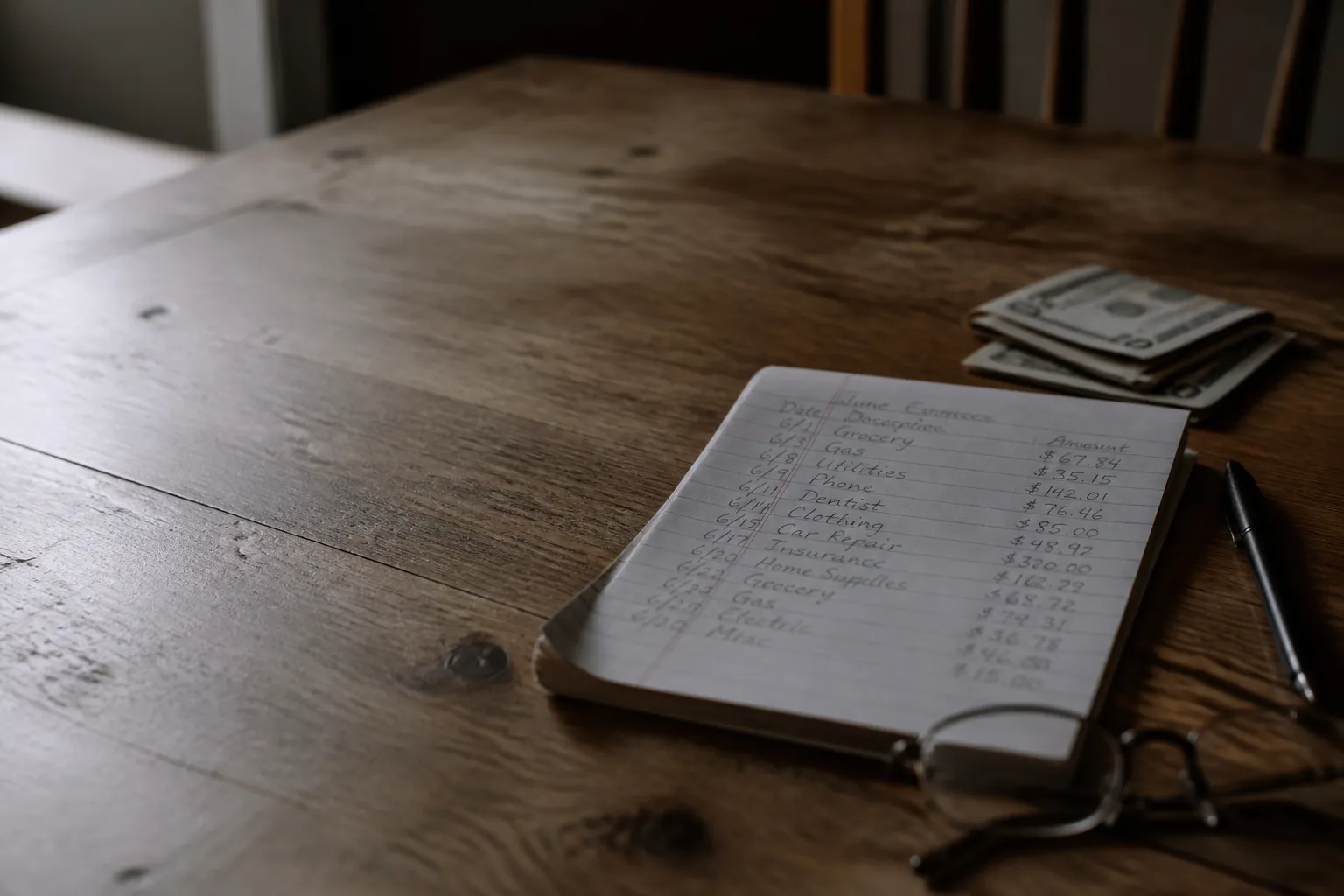
For cash, tracking means writing down every purchase, bill payment, money order, and fee when it happens. Not at the end of the week. A notebook works. So does a folded sheet of paper with columns for date, item, and amount. Ugly is fine. Complete is the goal.
After a month, read the record back with the questions the CFPB suggests:
- Which expenses surprised you?
- Which spending do you consider unnecessary?
- Which subscriptions or services are you paying for and not using?
- How does weekday spending differ from weekend spending?
Expect the first question to sting a little. That is the tool working.
Separate needs and obligations from wants
Next, sort every line into one of two piles. Needs and obligations are things like rent or mortgage, utilities, healthcare, and childcare. Wants are things like a gym membership, cable, or daily coffee. The CFPB describes this split as the starting point for setting priorities.
The math is plain. Add up the needs pile first. Subtract it from your monthly income. What is left is the most you can spend on wants, and also the most you can save. If the needs pile is bigger than your income, no sorting trick fixes that. It tells you the problem is income or fixed costs, and that is worth knowing.
Look hard at recurring charges. Small amounts repeated monthly add up faster than one big purchase. The CFPB tracker also asks you to look for service fees on financial services that could be eliminated. A fee you pay every month for a service you barely use is a want, even if it came disguised as a need.
Understand the protection risks of where your money sits
Paper cash has one big feature: you know exactly what you have. It also has one big problem. If it is lost or stolen, there is no deposit insurance to make you whole. The sources reviewed here do not go into storage, replacement, or theft, so check official consumer guidance before settling on a plan for keeping cash safe.
Payment apps are not a clean fix. The CFPB warns that money held in a nonbank payment app may not be covered by federal deposit insurance, because it may not sit at an FDIC member bank or an NCUA member credit union. The app can still show a balance and a list of transactions that look like a bank account. The CFPB says money in a deposit-insured account is generally safer than money held in such an app. Reported usage is high: more than three quarters of U.S. adults have used a payment app, according to the CFPB advisory.
The FDIC publishes consumer research, including its National Survey of Unbanked and Underbanked Households, if you want broader context. The sources here do not explain how to open an insured account or what to do if you cannot. For that, go to the FDIC directly.
Questions to answer as you build and adjust the plan
Treat month two as a test of month one. Did the categories hold? Which one drifted? Spending shifts with seasons, prices, and household changes, so a plan built on one month of records needs a check against the next.
Some pieces remain open, and it is better to say so than to guess:
- How to set the dollar amount for each category.
- How to handle irregular bills such as annual insurance or car repairs.
- How to pay bills that need a check, money order, or electronic payment.
The CFPB publishes tools on paying bills, but the copies available for this piece could not be read, so those details are unverified here. Look them up on the CFPB site.
You may also have heard of cash envelope budgeting, where money for each category is physically set aside. That is a popular idea, but the material here confirms little beyond the name. Read a detailed source before building around it.
This is general education, not advice for your situation. For specifics on accounts, bills, or taxes, check official sources or talk with a qualified professional.
Please seek a professional. This article is general information, not financial, tax or insurance advice. Please seek a licensed financial, tax or insurance professional about your own situation.


