










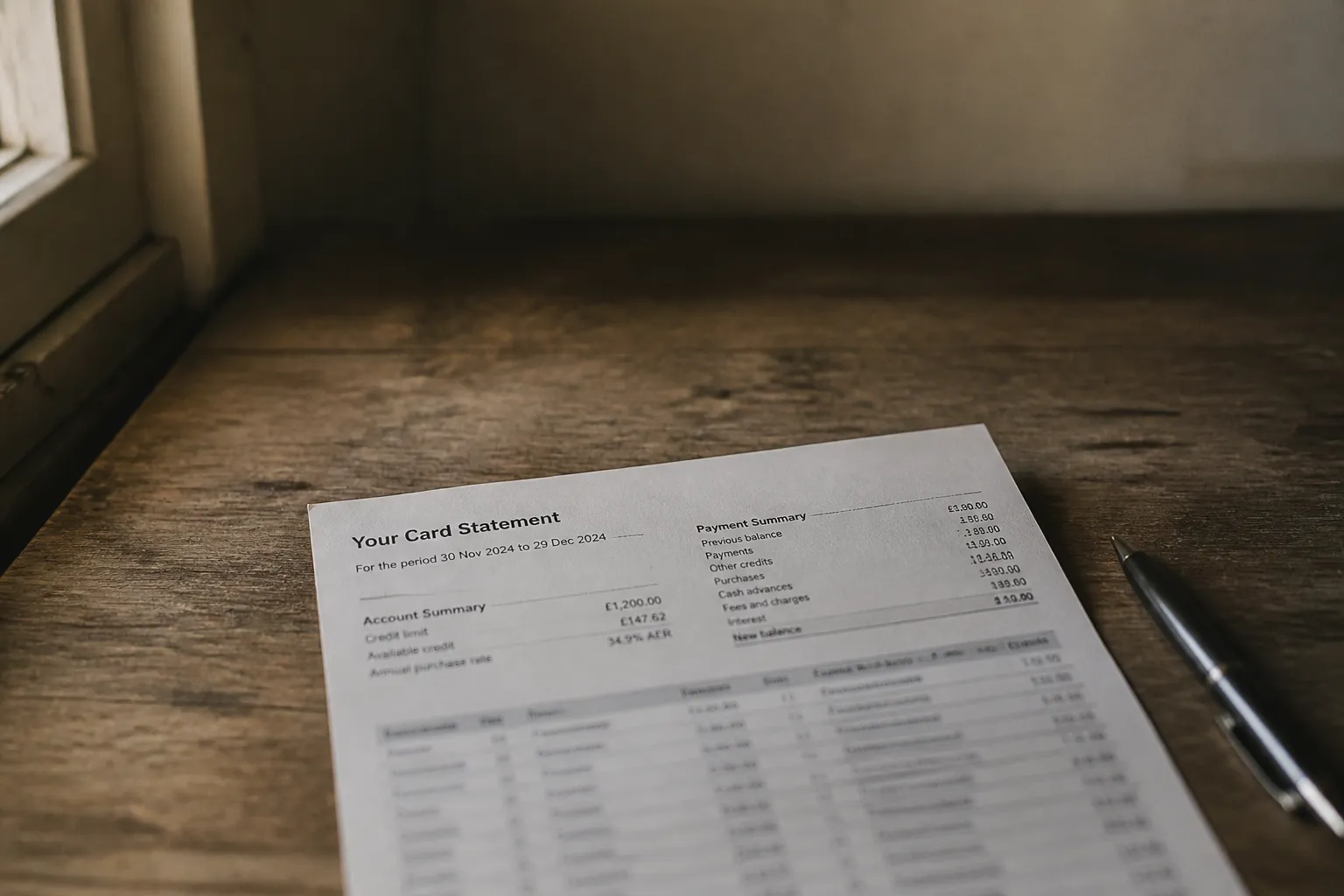
A minimum payment keeps your credit card account in good standing. It does not promise that your balance is shrinking in any hurry. For many people, the smallest required payment covers mostly interest, and the amount owed barely moves for months. This guide explains how that happens, what your statement is trying to tell you, and which questions are worth asking about your own account.
What a minimum payment does and does not do
A minimum payment is the smallest amount your card issuer requires you to pay by the due date. Paying it keeps the account current and avoids a late payment. It does not, by itself, cut the balance much. Part of each payment goes to interest and fees first, and only the remainder reduces what you owe. When the minimum is small compared with the balance, most of your money can go to the lender while the principal sits still.
You are not required to pay more than the minimum on your statement. Paying more each month, however, lowers the total interest you pay over time. The extra amount reduces the balance that keeps accruing interest, so the effect compounds in your favor. The Consumer Financial Protection Bureau (CFPB) states this plainly in its guidance on the payoff box, and it is one of the simplest levers you have.
Minimum-only payments also explain why a payoff timeline can look alarming. The CFPB notes that paying only the minimum could take years to clear a card balance, even when you stop adding new purchases. That is not a rare edge case. It is the normal result of paying the smallest allowed amount on a balance that carries interest every day.
How daily interest adds up on a carried balance
Many card issuers calculate interest daily. They take the average daily balance over the billing cycle and apply a daily periodic rate, which is your annual percentage rate (APR) divided across the days in the year. Each day that a balance sits unpaid, a small charge is added. The charges look tiny one at a time, which is part of why they are easy to overlook.
Timing matters too. Because interest runs on the daily balance, paying down what you owe sooner generally means less interest accrues. Without a grace period, reducing some or all of the balance early lowers the charge. The CFPB's explainer on interest calculations makes this point directly, and it is worth reading if you want the mechanics in plain language.
A grace period is the window between the end of a billing cycle and the due date when you can avoid interest on new purchases by paying in full. In most cases, that grace period applies only if you were not already carrying a balance from the prior cycle. Once you carry a balance, new purchases may begin accruing interest right away. That is the moment a manageable balance can start to grow faster than you expected.
Reading the payoff box and APR breakdown on your statement
Your statement is more useful than it looks. Card issuers must show how long it would take to pay off the current balance if you make no new charges and pay only the minimum each month. They must also show the monthly amount needed to pay off the balance in 36 months. That 36-month figure is based on the current balance and ignores future purchases, so treat it as a reference point rather than a promise.
Next, look at the APR breakdown. Each balance category must appear with its own APR and the amount in that category. Purchases and cash advances, for example, can carry different rates. Seeing the categories side by side shows which balances are costing the most. Many readers skip this section, and it is often the most informative part of the page.
If you pay more than the minimum but less than the full balance, the issuer generally must apply the amount above the minimum first to the balance with the highest interest rate. This rule means a larger payment can shrink your most expensive debt faster than the total balance alone would suggest. It is a useful detail when you decide where extra dollars should go, and a good thing to confirm with your own statement.
Where the cost of carrying a balance stands right now
Interest rates set the stakes. Figures from the Federal Reserve Bank of Philadelphia's large bank card data show average purchase APRs of about 24.1% for general purpose cards and 31.3% for private label cards. Both sit near the highest levels in that series going back to 2012. At rates like these, each month of unpaid balance costs more than it did in many earlier years.
The same data points to a wider premium over the prime rate, the benchmark that many card rates are tied to. After adjusting for the prime rate, the margin for both card types was at or near record highs in the series. In plain terms, borrowers are paying a bigger markup on carried balances, even after accounting for the general rate environment. Note that these numbers come from a specific data set and do not describe every account.
The CFPB's biennial review of the credit card market offers broader context. That review is required under the Credit Card Accountability Responsibility and Disclosure Act of 2009, and its underlying data runs through the end of 2024. It describes the market before the most recent quarterly figures, so it is best read as background rather than a snapshot of today. The data also shows fewer large bank accounts making only the minimum payment compared with a year earlier, which suggests more people are paying in full, though the trend does not tell you what your own account will do.
Questions to ask and what the sources leave out
Before you change anything, it helps to gather a few facts from your own statement. Start with these:
- How long would it take to pay off my current balance if I pay only the minimum?
- What monthly amount would clear the balance in 36 months?
- Do I have a grace period, and does it still apply to my purchases while I am carrying a balance?
- What is my daily periodic rate, and which APR applies to each balance type?
The sources behind this article also have gaps. They do not explain how a card issuer calculates the minimum payment amount. They do not reproduce the exact wording or formula of the required repayment disclosure. They also do not include a worked dollar example, so this article does not give a payoff time or total interest figure you can apply to your account. Nothing here shows how new purchases change the payoff timeline once a balance is already being carried.
Your statement and the disclosures from your card issuer are the most reliable place to find the numbers that apply to you. For questions about your specific situation, the CFPB and your card issuer are good places to start, and a qualified financial professional can help you weigh your options. This article is general education, not personal financial, legal, or tax advice.
Please seek a professional. This article is general information, not financial, tax or insurance advice. Please seek a licensed financial, tax or insurance professional about your own situation.


