











Most people look at the minimum payment and the due date, then stop. The interest section sits a little lower on the page, and it holds the answer to a simple question: why did I owe that much? Here is how to read it, section by section, with a few plain-language definitions along the way.
Why one statement can show more than one APR
APR stands for annual percentage rate, the yearly cost of borrowing on the card. Card issuers often charge one APR on purchases and different APRs on cash advances, checks written with the card, or other transactions. So the interest section may list several rates, not one. The Consumer Financial Protection Bureau (CFPB) explains that your statement should show each category with its own APR and the amount of the balance in each category.
Picture a statement with two lines. Purchases carry one rate. Cash advances carry a higher one. If you only see a single total balance with no breakdown, that conflicts with the disclosure the CFPB describes, and it is a good reason to call the issuer.
The statement tells you the result. The cardholder agreement tells you the rule. It lists the rates and which transactions and fees land in which category. If you cannot find it on the issuer's website, you can request a copy.
How the daily rate and average daily balance produce the charge
Many issuers calculate interest every day. The rate used each day is the daily periodic rate, which is roughly the annual rate spread across the days of the year. The issuer then looks at your average daily balance, meaning the balance you carried each day, averaged over the billing cycle.
That is why timing matters. Without a grace period, the sooner you pay down all or part of a balance, the less daily interest builds up. A payment made early in the cycle lowers more days of balance than the same payment made at the end.
Interest can also accrue on interest already charged, so carrying a balance compounds over time. For credit cards, the interest rate and the APR generally describe the same annual cost. The sources I reviewed do not give a worked example with real statement numbers, so ask your issuer to walk you through your own figures if the math looks off.
How the grace period and penalty rates affect what you owe
A grace period is the window when new purchases do not accrue interest. It usually applies only to new purchases, and usually only if you were not already carrying a balance. Once you carry a balance, interest on new purchases may start right away. That surprises people. They bought groceries, paid a little, and still saw interest on the groceries.
Paying the full balance by the due date each month generally avoids interest on purchases when a grace period applies. Here are the pieces that can change your rate:
- Penalty APR. A late or missed payment can trigger a higher rate. Federal law requires 45 days' notice before it is charged, and it typically does not apply during the grace period.
- Variable APR. Most cards use a rate tied to an index such as the prime rate. The cardholder agreement says how it can change.
- Fixed APR. Fixed does not mean frozen. The issuer can change it, but must notify you in advance.
Now the piece that most people assume works one way: where your money goes when you pay.
- Minimum portion. The issuer generally decides how to apply the minimum-payment part of your payment.
- Amount above the minimum. This generally goes to the highest-rate balance first, which can shrink the costliest balance faster.
- What is still unclear. The sources I used do not fully explain how a payment is split across balances, so confirm the details in your agreement.
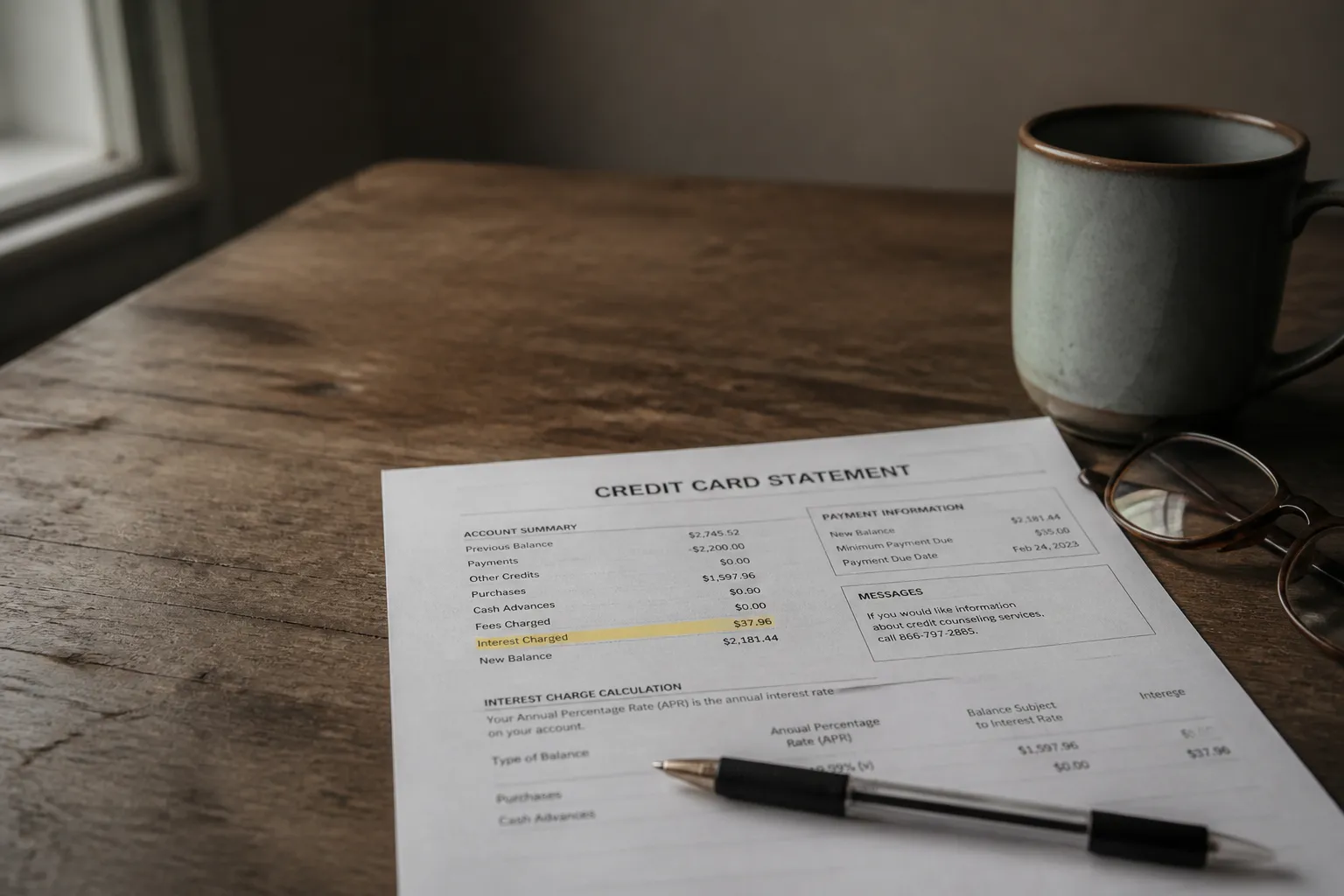
How payments are applied across balances
Say you carry $1,000 at a lower purchase rate and $300 at a higher cash advance rate. You pay the minimum plus $100. The extra $100 generally goes toward the higher-rate balance. That is useful to know, because the line with the biggest rate is where interest piles up fastest.
High balances carried from month to month can mean higher interest charges and can affect credit scores. I cannot promise any result for your score, but the link is worth understanding next to the rates themselves.
Questions to ask your card issuer
Start with the cardholder agreement. Then call the number on your card and ask:
- Which transactions and fees go into each balance category, and what rate applies to each?
- Is my rate variable? Which index is it tied to, and how and when can it change?
- Does my grace period still apply, or did I lose it by carrying a balance?
- How are my payments applied across balances with different rates?
- What notice will I get before a penalty APR takes effect?
Some gaps remain. The sources do not explain how balance-transfer or cash-advance fees feed into interest, or how to dispute a charge you think is wrong. Put those to the issuer directly. This article is educational only, so check the CFPB's consumer pages or a qualified professional for your own situation.
Please seek a professional. This article is general information, not financial, tax or insurance advice. Please seek a licensed financial, tax or insurance professional about your own situation.


